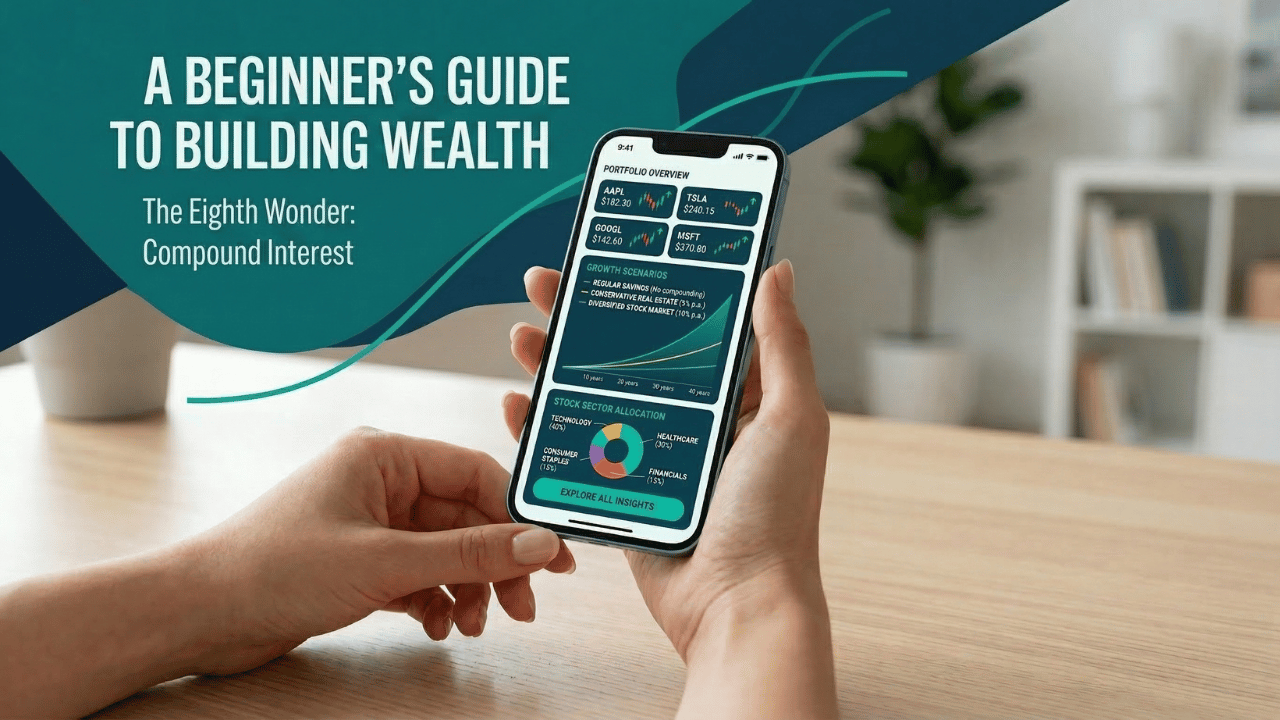
Key Takeaways:
- Time beats Timing: Starting today with a small amount is mathematically superior to starting later with a large amount.
- Inflation is the Enemy: Keeping wealth in cash is a guaranteed loss of purchasing power; compounding in shares (ETFs, etc) is the only reliable defence.
- Set it and Forget it: Automation removes the emotional stress of investing and ensures your wealth grows while you sleep.
- Fees are Wealth-Killers: A tiny 1% fee can wipe out nearly half of your potential 40-year gains—keep your costs low to keep your money.
Albert Einstein reportedly called compound interest the "eighth wonder of the world," adding that those who understand it earn it, and those who don’t, pay it. While that might sound like a dramatic quote for a math equation, in the world of personal finance, it is the absolute truth. Compound interest isn't just a financial tool; it is a mathematical engine that turns small, consistent habits into life-changing wealth.
At PocFin, our philosophy is simple: Set it, forget it, and thrive. We don't believe in the stress of day-trading or the anxiety of checking market tickers every hour. True wealth isn't built in a frantic sprint; it’s built in a long, quiet walk where you let time do the heavy lifting for you. This guide is designed to take you from the very basics of "What is this?" to the strategic execution of a "hands-off" investment portfolio.
The Foundation
What is Compound Interest? (The Snowball Effect)
To understand compound interest, you first have to distinguish it from its boring cousin: Simple Interest. Simple interest is calculated only on the principal amount—the original money you put in. If you put R1,000 in a jar and someone paid you 10% interest every year on that original R1,000, you’d get R100 every year. After 40 years, you’d have your original R1,000 plus R4,000 in interest. Not bad, but not "wealth."
Compound interest, however, is interest calculated on the initial principal plus all the accumulated interest from previous periods.
Think of it like a snowball at the top of a mountain.
Sarah started with a tiny snowball - just R100 a month - and pushed it down the hill of her 40-year career. By the time she reached the bottom, the snow it picked up in the first ten years was now picking up even more snow, creating a massive boulder she never could have carried herself.
When your interest begins to earn interest, the growth is no longer a straight line (linear); it becomes a curve that shoots upward (exponential). In the beginning, the growth feels slow—almost invisible. But as the years pass, the "interest on interest" component begins to dwarf your original contributions. This is the "PocFin Zen" secret: the hardest part is the beginning. Once the engine starts, your only job is to get out of the way.
The Silent Thief: Why Saving "Cash" is Losing You Money
Many people feel "safe" keeping their money in a standard savings account or, worse, under a mattress. They see the balance stay the same and think, "At least I’m not losing money."
This is a dangerous illusion. The silent thief is Inflation. On average, the cost of goods and services rises by about 2-3% every year. If your money is sitting in an account earning 0.01% interest, your purchasing power is actually shrinking.
Let’s look at the "25 to 65" scenario. Imagine you have R10,000 at age 25.
- The "Safe" Saver: You leave it in a standard account for 40 years. At 0.5% interest, you have roughly R12,200 at age 65. However, in 40 years, R12,200 will likely buy less than half of what R10,000 buys today. You didn't lose dollars, but you lost value.
- The Compound Investor: You put that same R10,000 into a low-cost ETF (Exchange Traded Fund) averaging 7% annually. At age 65, that R10,000 has grown to nearly R150,000.
By choosing "safety," the saver actually guaranteed a loss in lifestyle. By choosing the compound interest engine, the investor turned a modest sum into a retirement foundation.
The Comparison: Growth vs. Stagnation (40 Years)
| Investment Strategy | Initial Amount | Annual Return | Total at Age 65 | Purchasing Power |
|---|---|---|---|---|
| Cash / Mattress | R10,000 | 0% | R10,000 | Decreased (Heavy Loss) |
| Basic Savings | R10,000 | 0.5% | R12,208 | Decreased (Minor Loss) |
| ETF Investing | R10,000 | 7% | R149,744 | Increased (Wealth Built) |
The PocFin Philosophy (The "Zen" Investor)
Set It, Forget It, and Thrive
The biggest enemy of compound interest isn't the stock market - it’s the person staring at the screen. When you check your investments daily, you are tempted to react to the "noise." You see a 2% dip and you want to sell. You see a 5% jump and you want to buy more.
We advocate for the "Zen Approach." Compound interest is like planting a fruit tree. If you dig it up every week to check the roots, it will die. You must plant it in good soil (ETFs), water it regularly (monthly deposits), and then leave it alone.
We suggest checking your portfolio once a year, or even less. The market will fluctuate - it’s supposed to. But over 20, 30, or 40 years, the trend of the global economy has historically been upward. By automating your process, you remove the emotional burden of "investing" and turn it into a background process of your life.
The Power of the Monthly Deposit
While a lump sum is great, most of us build wealth through Monthly Deposits. This is where the magic really happens because of a concept called Dollar Cost Averaging.
When you set up an automatic deposit of, say, R200 every month into an ETF, you are buying more shares when the price is low and fewer shares when the price is high. You don't have to "time the market." You just have to "be in the market."
PocFin Pro-Tip #1: Use your banking app to schedule a transfer to your investment account the day after you get paid. If you never see the money in your spending account, you won't miss it. Automation is the highest form of financial discipline.
Safety First: The Emergency Fund Bridge
Before you start the compound interest engine, you need a safety net. We never want you to be forced to sell your investments during a market downturn because your car broke down or you lost your job.
Selling your investments early kills the compounding cycle. It’s like cutting down your fruit tree for firewood because you're cold today. To prevent this, you must have an emergency fund.
Before diving into the deep end of the market, ensure you have 3-6 months of expenses tucked away. If you aren't sure how to start, you can check out our guide on building an emergency fund here. Once that bridge is built, you can funnel every extra cent into your wealth-building engine with total peace of mind.
The Math of Time
The Tale of Two Investors: 5 vs. 25
The most important variable in the compound interest equation isn't how much money you have - it’s Time. To illustrate this, let's look at a "Best Case" vs. a "Standard Case" scenario.
- Investor A (The Headstart): Imagine a parent opens an account for their child at age 5 and puts in a one-time gift of R5,000. They never add another cent. At a 7% return, by the time that child is 65, that R5,000 has grown to over R300,000.
- Investor B (The Late Starter): This person waits until they are age 25 to start. To reach that same R300,000 by age 65, they can't just put in R5,000. They would have to put in roughly R20,000 upfront, or contribute hundreds of dollars every month for 40 years.
The 20-year delay for Investor B didn't just cost them time; it cost them an enormous amount of "free" money that Investor A got simply by existing. This is why we say the best time to start was yesterday; the second best time is right now.
Visualising the Curve: The Compound Interest Formula
To truly weaponise your wealth, you don’t need to be a mathematician, but you should understand the "engine" under the hood. The growth we’ve discussed follows a specific formula:
A = P(1 + \(r/n))^t
- A = the amount of money accumulated after n years, including interest.
- P = the principal amount (the initial amount you deposit).
- r = the annual interest rate (decimal).
- n = the number of times that interest is compounded per year.
- t = the number of years the money is invested for.
The PocFin Interpretation: Look closely at "t" (Time). In this formula, time is an exponent. While your principal (P) and your rate (r) add to the total, Time multiplies it. This is why a 20-year-old who invests R100 a month will almost always beat a 40-year-old who invests R500 a month. You cannot "buy" more time, which makes it your most valuable asset.
PocFin Pro-Tip #2: Don't let the math intimidate you. If you want to see exactly how your specific monthly contribution will look in 10, 20, or 40 years, use our PocFin Compound Interest Calculator here. It turns these complex exponents into a clear visual map of your future freedom.
Strategic Execution
Taxes and Fees: The Silent Compound Killers**
If compound interest is the engine of wealth, then taxes and management fees are the "friction" that slows it down. Over a 40-year horizon, even a tiny 1% difference in fees can cost you hundreds of thousands of dollars.
Many traditional banks offer "Mutual Funds" with management fees (Expense Ratios) of 1.5% or higher. They claim to "beat the market," but history shows that 90% of them fail to do so over the long term.
Compare this to a low-cost ETF (Exchange Traded Fund) that tracks the S&P 500, which might have a fee of only 0.03%.
The 40-Year Impact of a 1% Fee: Imagine two people invest R100,000 for 40 years with a 7% average return. • Investor A (Low-Cost ETF): Pays 0.05% in fees. Final balance: ~R1,470,000. • Investor B (High-Fee Fund): Pays 1.05% in fees. Final balance: ~990,000. Investor B lost nearly HALF A MILLION DOLLARS to fees. This is why the PocFin philosophy prioritises low-cost, broad-market ETFs. You keep the compound interest; the bankers don't.
Real-World Projections: The "Safe" vs. "Wealth" Comparison To drive home the point of inflation and growth, let's look at what happens to R500 a month over 40 years in different environments.
| Scenario | Monthly Deposit | Annual Growth | Total After 40 Years | Reality Check |
|---|---|---|---|---|
| The "Stasher" (Cash) | R500 | 0% | R240,000 | Lost 50%+ purchasing power to inflation. |
| The "Saver" (High-Yield) | R500 | 2% | R364,000 | Barely kept pace with inflation. Zero wealth created. |
| The "Zen Investor" (ETF) | R500 | 8% | R1,680,000 | Millionaire status. Significant wealth built. |
Advanced Rungs: ROI and Inflation-Adjusted Returns
As you become more comfortable with the "Set it and Forget it" lifestyle, you’ll hear terms like ROI (Return on Investment) and Real Returns.
- Nominal Return: The raw percentage your investment grew (e.g., 10%).
- Real Return: Your growth minus inflation (e.g., 10% gain - 3% inflation = 7% Real Return).
When planning your future using the PocFin Budgeting App, we always recommend using a conservative "Real Return" of 6-7% for your projections. This ensures that when you hit your "Freedom Number," the money actually buys what you expect it to buy in the future.
Conclusion: Your Future Self is Waiting
Compound interest is not a get-rich-quick scheme. It is a get-rich-eventually guarantee. It requires three things: Capital, Consistency, and a massive amount of Patience.
The hardest part of this journey isn't the math - it's the first three years. In the beginning, your interest will be small. You might only earn R10 in your first month, and it will be tempting to think, "Why bother?" But remember the snowball. Those first few flakes of snow are what allow the massive boulder to form decades later.
Your "Start Today" Checklist:
- Build the Bridge: Ensure you have your Emergency Fund ready (view our Why You Need An Emergency Fund in 2026 post.
- Automate: Set up a monthly transfer to a low-cost ETF.
- “Delete” the Apps: Stop checking the price every day.
- Visualise: Use the PocFin Compound Interest Calculator to see your 40-year curve.
Building wealth with PocFin isn't about being a genius; it's about being disciplined enough to let time do the work for you.
The Question for You: If you knew that every R100 you invested today would be worth R1,500 by the time you retired, what is one "unnecessary" expense you would cut this month to fuel your future?
Cheers,
The PocFin Team
Sign in to join the conversation.