Key Takeaways:
- Boundaries Beat Willpower: The core of the envelope method isn't about restriction; it’s about removing decision fatigue. By setting a hard limit for a category, you stop "guessing" if you can afford a purchase and start knowing.
- Digital Doesn't Mean Discipline-less: While we’ve moved away from physical cash, the "Gone is Gone" principle remains the most effective way to stop overspending. PocFin replicates this tactile discipline in a mobile environment.
- The "Carry-Over" is Your Accountability Partner: Unlike physical envelopes where overspending is often forgotten, digital carry-over logic forces you to face the truth. A deficit today is a "debt" you owe your future self next month.
- Data-Driven Adjustments: Continuous negative carry-overs are a signal, not a failure. They tell you exactly where you need to either increase your budget allocation or tighten your lifestyle habits based on real-world spending patterns.
- Automated Sinking Funds: Consistently spending less than your envelope’s limit allows you to build a "buffer" effortlessly. This turn-of-the-month rollover transforms a simple budget into a long-term safety net for unexpected expenses.
The Psychology of the Envelope: Why "Gone is Gone" Works
Think back to the first time you ever managed your own money. For many of us, it was a few notes or coins tucked into a physical envelope or a small wallet labeled "Pocket Money" or "School Fair." There was a visceral, tactile reality to that money. When you opened the envelope and saw it was empty, the conversation ended. There was no swiping a backup card or dipping into an invisible overdraft. The boundary was absolute.
This is the core Why behind the Envelope Method. It isn't just a math equation; it’s a behavioural guardrail. In an era of invisible digital transactions, we’ve lost that friction. When you pay for everything with a single tap, your brain struggles to categorise the cost of a coffee versus the cost of a utility bill - it’s all just numbers on a screen. The Envelope Method restores that friction by forcing you to give every Rand or Dollar a specific home before you spend it.
Why Physical Limits Create Mental Clarity
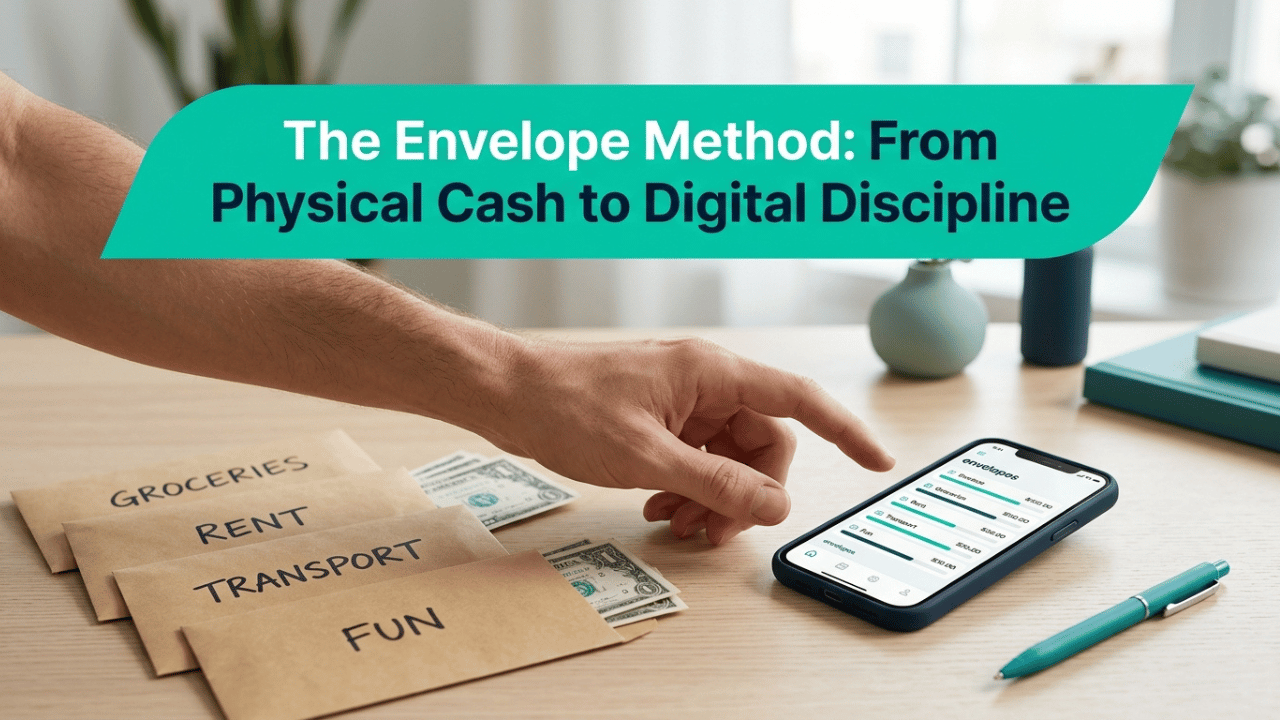
The traditional envelope method involves labelling physical envelopes with categories like Groceries, Dining Out, and Entertainment. At the start of the month, you fill them with cash. If the Dining Out envelope is empty by the 15th, you stop eating out. It’s that simple.
This works because it removes decision fatigue. You don’t have to wonder if you can afford a dessert; you simply look at the envelope. If the paper is there, you can. If it isn't, you can't. This visible limit is the most effective way to kill the habit of guessing your way through the month.
Setting Up Your First Digital Envelopes
While the nostalgia of cash is powerful, carrying around stacks of envelopes isn't practical in 2026. This is where we bridge the gap. In a digital environment like PocFin, we replicate this discipline without the physical bulk.
The first step for any beginner is identifying your "Hard" versus "Soft" spending categories.
- Hard Categories: These are non-negotiables. Rent, insurance, and car payments. Usually, these are fixed amounts.
- Soft Categories: This is where the Envelope Method shines. These are the variable costs where you usually "leak" money - groceries, fuel, hobbies, and impulse buys.
The Comparison: Physical vs. Digital
| Feature | Physical Envelopes | Digital Envelopes (PocFin) |
|---|---|---|
| Security | High risk (theft/loss). | Secured by encryption. |
| Convenience | Low (carrying cash). | High (accessible via phone). |
| Overspending | Impossible (physically empty). | Tracked (carried over to next month). |
| Visibility | Manual counting required. | Real-time analytics and history. |
Your First Month: Allocating the Balance
When you start, your goal isn't to be perfect; it's to be honest. If you think you spend R4000 on groceries but you actually spend R5000, your Groceries Envelope will be empty by week three.
In the digital era, the "Gone is Gone" rule evolves. Instead of the transaction being declined at the register, a digital system tracks the deficit. This is a crucial mental shift: A digital overspend is a debt you owe your future self.
The PocFin Evolution: Digital Boundaries
In PocFin, you create these envelopes as digital categories. Each one acts as a silo. When you record an expense, you aren't just subtracting from a Total Balance - you are specifically draining one envelope.
Moving from Limits to Logic
The beauty of the modern take is that you no longer need a calculator at the kitchen table. When you assign R500 to your "Fuel" category, the app maintains that boundary for you. You get the same pocket money discipline we had as kids, but with the added benefit of seeing exactly when and where that money disappeared.
Remember the feeling of checking your pocket money envelope and realising you had just enough left for that one toy you wanted? Moving that logic into your phone gives you that same "win" every time you stay under budget for the month.
By creating these distinct categories, you stop the bleed. You no longer accidentally spend your electricity money on a Friday night dinner because those two envelopes never touch.
Mastering the "Carry-Over" Logic: The Modern Envelope Advantage
While the physical envelope method was effective, it had a major flaw: it was static. If you had R100 left in your "Groceries" envelope at the end of the month, you either spent it impulsively to "reward" yourself or shoved it into a jar where it lost its category-specific purpose. Even worse, if you overspent by R200, you usually just took it from another envelope and forgot the "debt" ever existed.
In PocFin, we’ve evolved this into Carry-Over Logic. This is the secret sauce that turns a simple budget into a long-term financial strategy.
The Surplus: Rewarding Your Future Self
When you spend less than you allocated, that money doesn't just vanish. It stays in that specific envelope and "rolls over" into the new month.
Imagine you budgeted R1000 for Home Maintenance but spent R0. Next month, you don't just have R1000; you have R2000. This creates a sinking fund effect automatically. You aren't just budgeting; you’re building a buffer within your categories. This allows you to handle those inevitable rainy day expenses (like a burst pipe or a new car battery) without ever breaking your primary budget.
The Deficit: Facing the Truth
This is where the digital envelope method becomes a true accountability partner. In the physical world, if you overspent, you just felt guilty. In PocFin, the system remembers.
If you spend R220 on "Dining Out" when your envelope only had R200, you will see a -R20 carry-over.
- The Result: Next month, your R200 allocation starts at R180.
- The Lesson: You are forced to "pay back" your overspending. This stops the cycle of "I'll do better next month" because your past choices directly impact your current limits.
PocFin Pro-Tip: Use the "Carry-Over" feature to gamify your savings. Try to see how "thick" you can make your Fuel or Grocery envelope over three months by finding small ways to save each week.
Using Analytics to Resize Your Envelopes
The biggest mistake beginners make is setting "perfect" numbers that don't match reality. You might want to spend R3000 on groceries, but if your carry-over is consistently negative for three months, your envelope is the wrong size.
Spotting the "Leaky" Envelope
PocFin provides the analytics to see the lifecycle of your envelopes. By looking at your history, you can answer two critical questions:
- Is this a discipline problem? (You overspend on "Hobbies" because of impulse buys).
- Is this a math problem? (Inflation has simply made "Groceries" more expensive, and R3000 is no longer realistic).
The modern take on the envelope method is that it is fluid. If the data shows you consistently have R50 left in Utilities but are always R50 short in Petrol, you can click a few buttons and reallocate those funds for the following month. No crazy math or manual ledger entries required - just data-driven decisions.
Comparison: Handling the "End of Month"
| Scenario | Traditional Cash Method | PocFin Digital Method |
|---|---|---|
| Money Left Over | Usually spent or lost in a drawer. | Automatically rolls over to boost next month's limit. |
| Overspending | Borrowed from another envelope (easy to forget). | Recorded as a negative balance; deducted from next month. |
| Calculation | Manual counting and subtraction. | Real-time, automated carry-over calculation. |
| Long-term View | Hard to track trends over 6 months. | Instant charts showing envelope growth or depletion. |
Beyond the Envelopes: What Else is Out There?
While the Envelope Method is our gold standard for control, it’s worth noting that it can work alongside other popular strategies. Once you’ve mastered your envelopes, you might find yourself curious about:
- The 50/30/20 Rule: A high-level view where 50% of income goes to Needs, 30% to Wants, and 20% to Savings. (You can use PocFin envelopes to manage the "30% Wants" section specifically!)
- Zero-Based Budgeting: Ensuring every single cent has a job. The Envelope Method is essentially a form of Zero-Based Budgeting, but with walls between the categories.
Conclusion: Your Next 30 Days
The envelope method has survived for decades for one reason: it works. Whether it's the physical pocket money of the past or the smart carry-over logic of PocFin today, the principle of "limits" is the only way to truly master your money.
By moving your envelopes into a digital space, you aren't losing the discipline - you're gaining the data to make better choices. You no longer have to guess where you stand; you just have to look at your envelopes.
Your Next Step: Open your PocFin app today and create just three envelopes for your most "troublesome" categories (e.g., Dining Out, Groceries, and Hobbies). Commit to recording every expense in those categories for 30 days and see what your carry-over looks like on the 1st of next month.
Quick Question: Do you remember having a "pocket money" envelope as a kid, or did you dive straight into cards and apps? How did that change the way you value a dollar today?
Cheers,
The PocFin Team