Key Takeaways
- The End of Spreadsheet Fatigue: Understand how PocFin automates the tedious math of rolling balances, saving you hours of manual entry every month.
- The "Living Budget" Philosophy: Learn why treating your budget as a continuous journey - rather than a 30-day sprint - is the secret to long-term financial discipline.
- Mastering the "Overspend Ghost": Discover how negative carry-overs act as an automated accountability partner, helping you identify and fix leaks in your spending habits.
- Optimizing Your Surpluses: Gain strategies for "harvesting" positive carry-overs to accelerate your savings, investments, or debt repayments.
- The Monthly Decision Framework: Move beyond passive tracking and learn how to use rolling data to make proactive, high-level pivots in your financial plan.
For years, the world of personal finance has been obsessed with a single, flawed date: the 1st of the month. We’ve been taught that budgeting is a sprint that starts at midnight on the 1st and ends on the 30th or 31st. You set your numbers, you track your spending, and then - regardless of whether you crushed your goals or blew your account on a weekend getaway - you hit a "reset" button and start from scratch.
But life doesn’t work in 30-day vacuums. Your car doesn't care that it’s the 1st of the month when the alternator fails, and your savings goals don't simply vanish because the calendar turned a page. When you treat your budget as a series of isolated sprints, you lose the narrative of your money. You lose the "why" behind your wealth.
At PocFin, we believe your budget should be a living plan. It shouldn’t be a static document that gathers digital dust; it should be a breathing entity that adapts, remembers, and carries the momentum of your financial decisions from one season to the next. The heartbeat of this philosophy is the Carry Over Feature.
Beyond the Monthly Reset: Why Your Budget Needs to "Breathe"
The traditional "Monthly Reset" is a psychological trap. It offers a false sense of a clean slate that often masks systemic overspending. If you overspent on groceries by R100 in June and simply "reset" in July, you haven't actually solved the problem - you've just buried the evidence.
The Spreadsheet Trap: Why Manual Carry-Overs Usually Fail
Before PocFin, the only way to achieve a truly continuous budget was through complex, fragile spreadsheets. You know the feeling: it’s Sunday night, you’re staring at 14 different tabs, trying to remember if you manually added the R45 leftover from your "Utilities" cell into the next month’s starting balance.
The manual carry-over process is so tedious and prone to human error that most people eventually stop doing it. When the math gets hard, the discipline fades. This "Spreadsheet Fatigue" is exactly why we built the Carry Over logic directly into the core of the PocFin experience. We wanted to remove the friction of the "New Month" transition so you could focus on the decisions, not the calculations.
The Psychology of Continuity: Why the 1st is Not "Day 0"
When you know your balances will carry over, your behaviour changes. You stop seeing leftover money at the end of the month as a license to splurge. Instead of thinking, "I have R500 left in my entertainment budget, I better spend it before the month ends," you start thinking, "If I don't spend this R500 today, I’ll start next month with a R500 head start."
This shift from a "use it or lose it" mentality to a "save it and grow it" mindset is the secret sauce of long-term wealth. By making the budget a living thing, PocFin encourages you to value your future self as much as your current self.
The Mechanics: How the Rolling Balance Actually Works
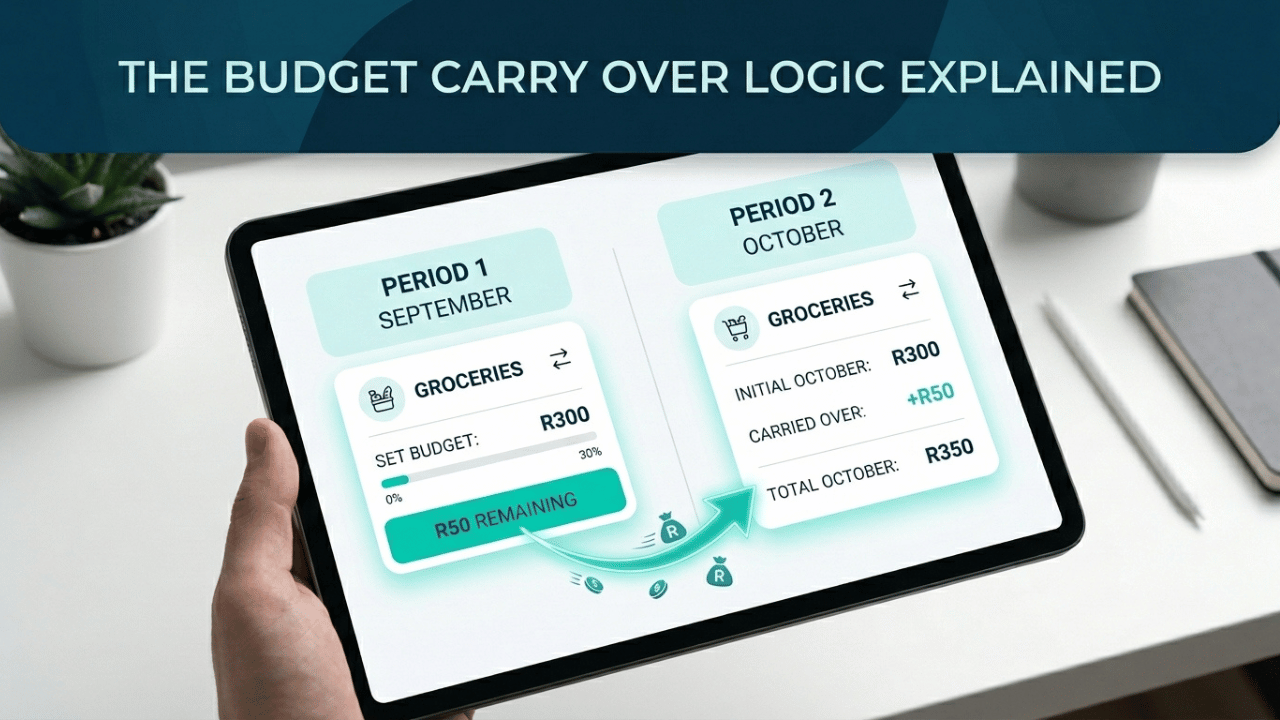
While the philosophy is high-level, the mechanics are elegantly simple. The Carry Over feature operates on a "Rolling Balance" logic. Think of it as a relay race: the closing balance of a category this month becomes the starting "bonus" or "penalty" for that same category next month.
Positive Carry Over: Reward Your Past Self
A positive carry-over occurs when you spend less than you allocated to a specific category. In PocFin, this surplus doesn't just disappear into a generic "savings" void. It stays right where you put it - in the category you worked hard to manage. If you allocated R500 for Home Maintenance but only spent R250, you have a R250 surplus. When you move into the next month, PocFin adds that R250 to your new monthly allocation.
Use positive carry-overs to build Micro-Sinking Funds. By letting surpluses roll over in categories like "Gifts" or "Car Repairs," you’re essentially building a dedicated emergency fund for those specific needs without even trying.
Negative Carry Over
This is where the discipline kicks in. If you overspend in a category, PocFin doesn't let you off the hook. A negative balance is deducted from your next month’s allocation for that same category. If you overspent your Dining Out budget by R100, you’ll start next month with R100 less in that envelope. This overspend serves as a gentle, automated reminder of your past choices. It forces a pivot - it asks you to either tighten your belt next month or make a conscious decision to move funds from another category to cover the gap.
The Math Behind the Curtain
The logic follows a simple formula:
Starting Balance Next Month = (Monthly Allocation) + (Carry Over Amount From Previous Month).
By automating this, PocFin ensures that your total net worth is always reflected in your budget plan. You aren't just tracking what you think you have; you are managing the reality of what is actually there.
PocFin vs. The World: Why Living Plans Beat Account Trackers
Most financial apps on the market today are "Post-Game Analysis" tools. They link to your bank account, pull in your transactions, and tell you - often days after the fact - that you’ve spent too much. They are mirrors, showing you what has already happened.
The Problem with Bank-First Apps
Bank-syncing apps often create a passive budgeting experience. Because the app does all the work, the user often stops looking at the plan. When the budget is just a reflection of a bank account, it becomes reactive. You spend, the app tracks, and you feel guilty.
PocFin flips the script. We aren't an account tracker; we are a Planning Engine.
| Feature | Traditional Tracking Apps | PocFin Living Plan |
|---|---|---|
| Data Source | Reactive (Bank Feeds) | Proactive (User-Defined Plan) |
| Month-to-Month | Hard Reset (Starts at $0) | Continuous (Rolling Balances) |
| Logic Focus | What you did | What you will do |
| User Engagement | Low (Set and forget) | High (Living, adaptive decisions) |
Freedom Through Friction: Why the "Few Buttons" Matter
The logic was made to be a click of a few buttons to handle the carry-over. This is an intentional design choice. While we automate the math, we keep the decision in your hands. You get to decide what to do with the left-over amounts - whether its going to a savings goal or a holding account or just to the next month, you decide.
This small amount of friction is vital. By requiring you to engage with the carry-over at the start of the month, PocFin ensures you are aware of your financial position. You can't ignore a negative balance when you have to actively decide how to handle it. This is how PocFin’s Budgeting System Works - it’s a smarter, simpler way to master your money because it keeps you in the driver’s seat.
Whether you are Creating Your First Budget With The PocFin App or you are a seasoned pro, understanding this rolling logic is the key to moving from surviving to thriving.
Advanced Strategy: Making the "Monthly Decision"
The magic of PocFin happens when the automation ends and your intuition begins. While the carry-over logic ensures the math is perfect, it also sets the stage for what we call the Monthly Decision. This is the moment you transition from a passive observer of your money to a proactive manager.
Analysing Trends: When a Negative Balance is a Signal
It is easy to view a negative carry-over as a failure, but in a living budget, it is actually a data point. If your Electricity category is consistently carrying over a negative balance of R200 every month, the app is telling you that your initial plan is no longer aligned with reality.
Instead of fighting the rolling balance, this is your cue to pivot. You might need to increase that category’s monthly allocation by moving funds from a lower-priority area. This isn't failing at your budget; it is optimising it based on real-world evidence.
Moving Surplus: From Leftover to Levelling Up
On the flip side, positive carry-overs shouldn't always stay in their original envelopes indefinitely. If your "Home Maintenance" fund has rolled over for six months and now sits at a massive surplus, you have a strategic choice to make.
Do you keep it there for a major future repair, or do you harvest that surplus to accelerate a debt payment or an investment? This is the beauty of the PocFin system: because the budget is a living thing, you can move these accumulated wins across your plan without breaking the underlying logic.
Once a quarter, do a "Surplus Audit." Look for categories where the carry-over balance has grown to more than 3x your monthly allocation. This is often "lazy money" that could be working harder for you in an interest-bearing account.
The Evolution of the Budget: Why This Logic Wins
When we look at the future of personal finance, it’s clear that the old way of "tracking and crying" is dead. People want systems that act as a co-pilot. By using rolling balances, PocFin effectively handles the Time Value of Budgeting.
The Math of Consistency
Think of your budget like a compound interest formula. If you manage your "leaks" (the negative carry-overs) and protect your "surpluses" (the positive carry-overs), the net effect on your wealth is exponential.
Small, rolling adjustments are far more effective than massive, once-a-year financial overhauls. The carry-over feature ensures that a 1% improvement in your spending habits this month is captured and carried forward into the next, creating a snowball effect of financial discipline.
A Tool for the Technical Mind
For the user who wants to understand the "why" behind the app, the carry-over logic represents a shift toward Accrual-Based Personal Budgeting. You aren't just looking at cash flow; you are looking at obligations and resources over time. This level of technical depth is what makes PocFin a robust tool for those who are serious about the mechanics of their wealth.
Conclusion: Your Budget, Evolved
A budget that resets every month is just a list of guesses. A budget that carries over is a history of your priorities.
By embracing the rolling logic of PocFin, you stop fighting against the calendar and start working with the natural flow of your life. You save time, reduce the "Sunday night spreadsheet panic," and - most importantly - you build a relationship with your money based on honesty and continuity.
The feature is already there, humming along in the background. It’s waiting for you to stop seeing the 1st of the month as a deadline and start seeing it as a transition in a much larger, more successful journey.
Next Steps for You:
- Audit your carry-overs: Open the app and look at your current rolling balances.
- Identify one Overspending Category: Where are you consistently in the red, and what is the one trade-off you can make this month to fix it?
- Celebrate a surplus: Find a category that is rolling over in the green and decide if that money stays there or moves to a bigger goal.
A question for feedback! Does seeing your overspending roll over into the next month make you more disciplined, or do you prefer to "clear the slate" and start fresh?
Cheers,
The PocFin Team